
Grovedale and Mount Duneed sit at the southern edge of Geelong, where new master-planned estates meet older suburban streets. The Armstrong Creek growth area is reshaping this part of the city, drawing young families chasing space, schools and a coastal lifestyle within reach.
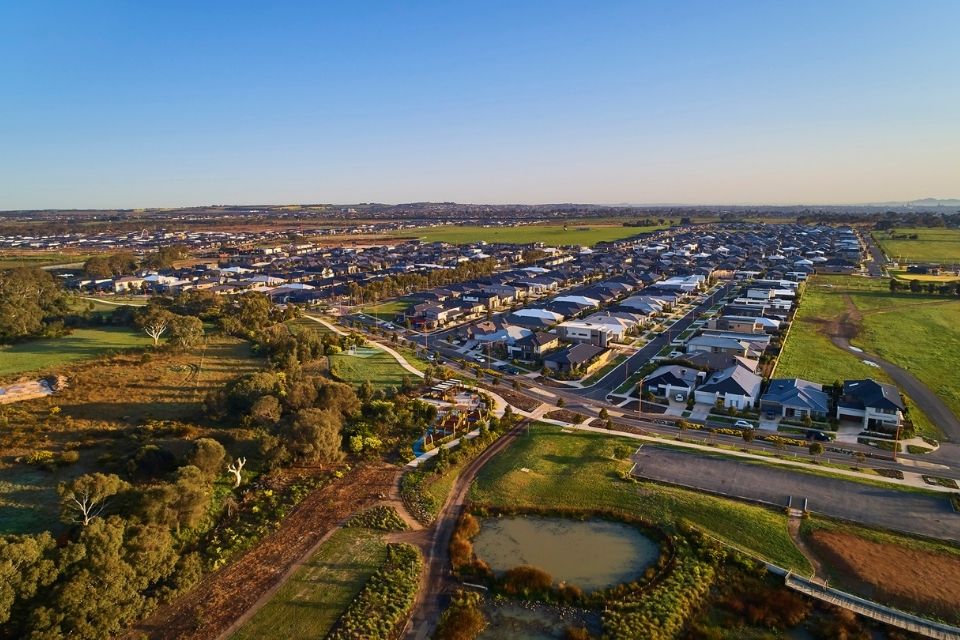
Drive south out of Geelong along the Surf Coast Highway and the city loosens. Older Grovedale streets give way to the Armstrong Creek growth area, where bulldozers are still turning paddocks and grazing land into estates with names like Armstrong, Warralily and Ashbury. The extinct volcano of Mount Duneed itself rises quietly to the south, its old crater preserved as a recreation reserve.
This is one of the largest master-planned growth areas in Victoria, gazetted in 2012 and still building out. Torquay's beaches are a short drive south, the Geelong Ring Road is minutes away, and a community of young families is forming in real time around new schools, new sports clubs, and streets where most neighbours arrived in the last few years.
Mortgage pressure is the quiet weight in many of these new homes. People stretched into a build during low rates and are now watching repayments climb. Loneliness sits underneath the brand-new streets where neighbours have not yet become friends. Commute fatigue is real for those still travelling to Melbourne. And in the older Grovedale pockets, the social drift of post-industrial Geelong, including men's mental health and intergenerational unemployment, has not disappeared just because new estates went up next door.
The anchors are junior sport, school gates, the Club Armstrong residents' facilities, the parklands along Armstrong Creek, and the slow gravity of local cafes and the shopping village. Nothing flashy. Largely the rhythms of family life, weekend footy, and people trying to build a community from scratch in real time.
The numbers tell a clear story. A young-adult share well above the national average, a strong concentration of families with children, and a population approaching twenty-five thousand inside one of Victoria's largest active growth fronts. Nearly half non-religious, with a significant unchurched population that is open and demographically primed.
The cultural moment is unusual. A whole community is being formed at once. Schools, sports clubs, neighbourhood identities and friendship networks are still being built by the people moving in. A church embedded in that formation, present at the start rather than arriving later, has a rare chance to shape the social fabric rather than push against an established one.
The challenge is honest. Building from scratch in a transient, mortgage-stretched, time-poor population is slow work, and the existing Pentecostal options in central Geelong already absorb some of the missional oxygen. The opportunity is just as honest. Few growth areas in Australia combine this scale, this demographic profile, and this lack of a contemporary church footprint inside the new estates themselves.
Nearly half of residents tick no religion on the census, noticeably above the national figure, and the share identifying as Christian sits a little under the national average. The trajectory is the familiar Australian one of soft drift, where most people are not hostile to faith but have no living connection to a church, no religious vocabulary in the home, and no sense that Sunday mornings are spiritually loaded. For young families settling here, faith is one of many options to consider rather than a default to inherit.

Pentecostal and charismatic presence in the wider Geelong area is real but thin once you cross south of the railway. Planetshakers has a Geelong campus meeting in Grovedale, Hillsong planted in 2019 and gathers in central Geelong, and Gateway Church (ACC) has been a long-standing presence in the city since 1984. Beyond these, the southern growth area is largely served by traditional parish churches, the Catholic system, and Grovedale Baptist.
The gap is a contemporary, family-shaped expression of faith embedded inside the Armstrong Creek growth area itself, where tens of thousands of people are settling and most have no current church connection. Many drive past brand-new community centres, ovals and shopping villages on Sunday morning with no obvious Pentecostal door open within walking distance of their estate.
Cost of Living and Housing. Grovedale carries the older, more affordable end of the housing stock, with established homes on bigger blocks. Mount Duneed and the surrounding Armstrong Creek estates sit higher up the price ladder, where new four-bedroom builds and increasingly seven-figure sales are reshaping expectations. Mortgage stretch is real for many of the young families buying in.
Schools and Kids. Grovedale College is the long-standing public secondary option, founded as a tech high school in 1979. Mirripoa Primary serves the newer estates, with Geelong Lutheran College close by. Several new primary schools have opened across the growth area, and more are in the precinct structure plans as families keep arriving.
Weekend Life. Saturdays revolve around junior sport, the parklands along Armstrong Creek, and the 30-plus kilometres of walking and bike paths threaded through the growth area. Torquay's surf beaches are roughly a 15-minute drive. The Bellarine wineries sit a short drive east, and the Great Ocean Road begins just down the highway.
Town Centre and Vibe. Waurn Ponds Shopping Centre serves the older Grovedale catchment to the north, while Armstrong Creek Town Centre anchors the newer southern estates. The smaller Mt Duneed Village is filling in the local-shop layer with an IGA, chemist, cafes and medical services for residents who would rather not get back in the car.
Nightlife and Culture. This is family suburbia, not a nightlife district. The cultural pull is into central Geelong for restaurants, the waterfront and live music, or south to Torquay for the surf-town pub and cafe scene. Locally, Club Armstrong functions as a social hub for the Villawood estate community, with pools, a gym and function spaces.
Geelong CBD. 10 to 15 minutes by car up the Surf Coast Highway. Restaurants, the waterfront, the hospital and the regional government precinct sit at the end of a short commute.
Waurn Ponds Train Station. Around 5 minutes away. The Warrnambool line runs through to Marshall and on to Melbourne, putting Southern Cross within reach for commuters.
Torquay and the Surf Coast. Roughly 11 to 15 minutes south. The beaches at Jan Juc and Bells, plus the surf-town shops and cafes, are part of the local lifestyle pitch.
Deakin University Waurn Ponds. Under 10 minutes by car. The campus draws students, researchers and a growing knowledge-economy workforce into the southern Geelong area.
Melbourne CBD. Around 90 minutes via the Geelong Ring Road and the Princes Freeway, longer in peak. A genuine commute for some, an occasional trip for most.
Avalon Airport. Roughly 35 minutes via the Ring Road. Domestic flights to Sydney, Brisbane and the Gold Coast run from here.
Saturday morning along the walking trails and at the Armstrong Creek sports ovals, the picture sharpens. Young couples pushing prams. Tradies who built half the houses in the next street. Healthcare workers from Geelong's hospitals. Public servants who shifted south when departments relocated. Teachers from the swelling school catchments. A lot of the population are people in their late twenties and thirties who priced out of inner Geelong or wanted more block for the same money than Melbourne's outer fringe could offer.
The older Grovedale streets carry a longer-rooted Geelong working-class character, including multi-generational families with ties to the former Ford plant, Alcoa and the city's industrial past. The newer estates skew younger, more aspirational and more transient, neighbours still learning each other's names. There is also a notable First Nations presence in the area, with Wadawurrung Country reaching across this part of the Bellarine and connections that run back well before European settlement.
Family-stage, comfortable in a young-kids world, happy at the sideline of an under-eights footy game on a windy Saturday. Builds slowly, listens well, holds the long view through a few years of small numbers. Comfortable with both the tradie ute and the inner-Geelong professional, because both live in the next street.
Not someone chasing a quick crowd or a city brand. The fit here is a planter who can pastor a community into existence rather than parachute one in, who understands suburban loneliness, mortgage stress and the texture of a master-planned estate, and who genuinely loves Geelong rather than treating it as a stepping stone.