
Mascot sits seven kilometres south of Sydney's CBD, wedged between the airport and the inner south. Half its residents are aged 15 to 34. It's a high-rise suburb of Mandarin-speaking professionals, Indonesian students and young renters in transit.
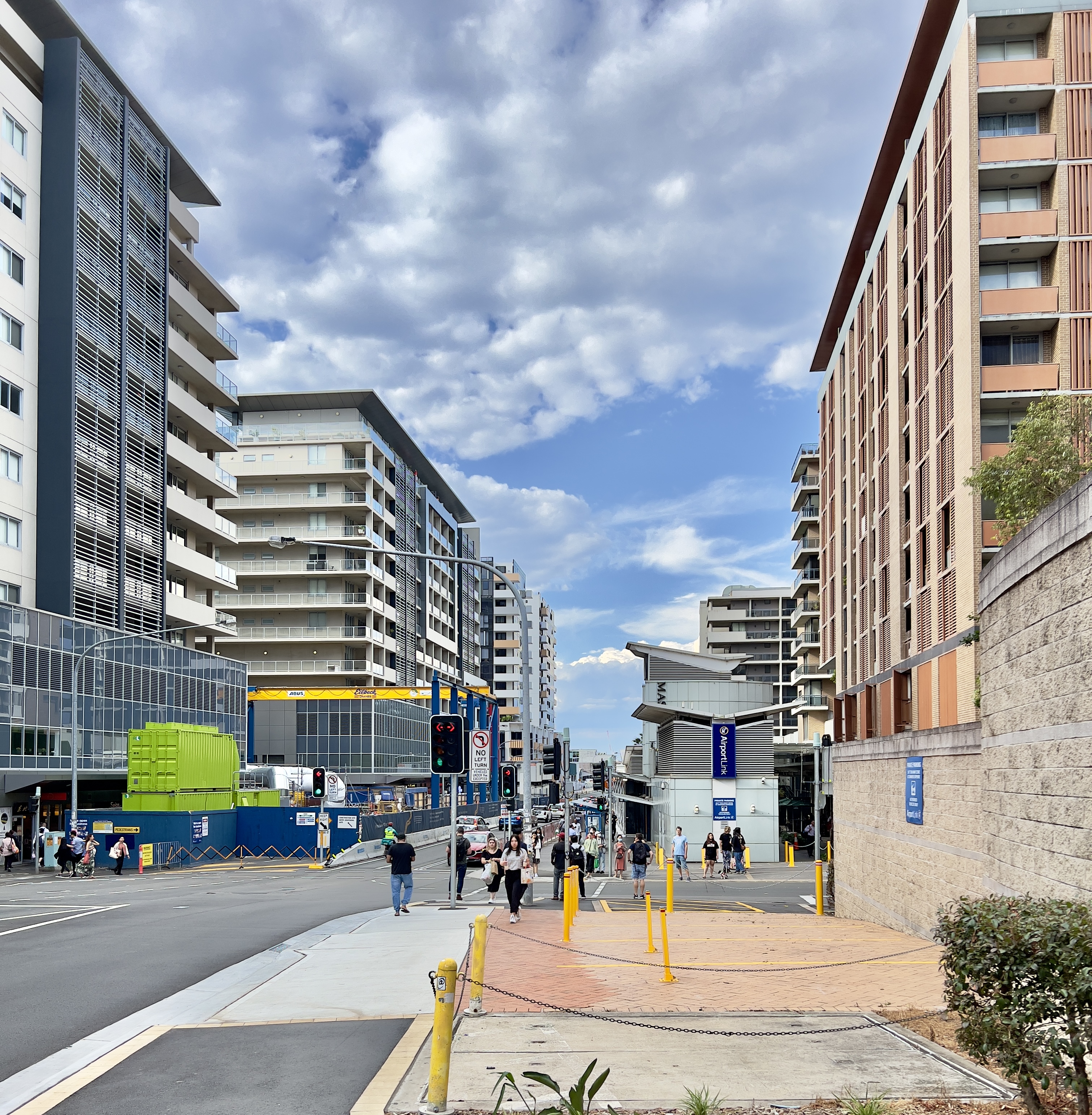
Drive south from the city down Botany Road and Mascot rises around you in glass and concrete. A decade ago this was warehouses, panel-beaters and post-war cottages on the edge of the airport. Now it's apartment towers, Meriton precincts, Qantas headquarters and the constant rumble of jets overhead.
The suburb sits in Bayside Council, on Gadigal land, hemmed in by Sydney Airport to the south and the rail line to the west. The old industrial Mascot is still here in pockets. The new Mascot is young, transient and overwhelmingly apartment-dwelling, with a shopping centre that wakes up at 7am for the airport crowd and a population that turns over fast.
Mascot's ache is anonymity. People move in for the airport job, the CBD commute or the cheaper apartment, and many leave again within two or three years. Neighbours in the same tower don't know each other. Renters cycle through. International students arrive lonely and often stay lonely. Aircraft noise, mortgage stress and the relentless pace of inner-Sydney life sit underneath the gloss of new buildings.
The anchors are smaller and more dispersed than in a traditional suburb. Sydney Park on weekends. The junior soccer and rugby league clubs at L'Estrange Park. The Greek Orthodox community around Coward Street. Mascot Library, the local schools, and the cafes along Botany Road that staff recognise the regulars at. The local Catholic and Greek congregations carry a long memory of the older Mascot.
Mascot carries an unusual combination: extraordinary density of young adults, a deeply multicultural population with strong Chinese and Indonesian threads, and very limited contemporary church presence inside the suburb itself. Half the residents are 15 to 34. One in eight households speaks Mandarin. Christian affiliation still sits at 40.8%, suggesting a meaningful pool of cultural and lapsed Christians who could be reached.
The cultural moment is also right. Inner-south Sydney is filling with apartment-dwelling young professionals and international students who arrive without church connection and without an obvious one to find. The loneliness in this demographic is real and well-documented. A church that can name that ache, build genuine community, and speak across Anglo, Chinese and Indonesian lines could meet a hunger that the existing Catholic and Orthodox parishes are not structured to address.
The challenge is honest: high turnover, competing priorities, expensive venue space, secular drift among under-35s, and the sheer density of options for how a young Sydneysider spends a Sunday morning. None of that diminishes the opportunity. It simply names it.
Mascot is less secular on paper than the national picture, with non-religious residents at 35.1% against a national figure closer to 39%. But that headline hides the real story: a large Catholic identity tied to Italian, Filipino and Spanish-speaking heritage, a significant Orthodox Christian community, and a growing cohort of Chinese and Indonesian residents whose religious identities are diverse and often nominal. Practical secularism is the lived reality for most under-35s here, regardless of what they ticked on the census.

The established religious presence in Mascot is overwhelmingly Catholic, Greek Orthodox and Uniting, with St Therese Mascot, St Joseph's Rosebery, St Catherine's Greek Orthodox on Coward Street, and Mascot Wesley Uniting all serving the older suburb. Knox Presbyterian dates back to 1911. These are heritage congregations, several with significant migrant memberships, and they hold a particular kind of space.
What's largely absent is a contemporary, English-speaking, young-adult-oriented church inside the suburb itself. Hillsong's city campuses and C3 SYD sit a 10 to 15 minute commute away in the city or Waterloo, and serve some of the Mascot demographic, but there is no walk-from-your-apartment Pentecostal or charismatic option for the 10,980 young adults living here. For a suburb where over half the residents are 15 to 34, that is a significant gap.
Cost of Living and Housing. Mascot is an apartment suburb. Around three-quarters of dwellings are flats or units, with separate houses making up only about a fifth of the stock. Buyers are stretched, renters dominate, and the apartment towers around the train station price in the airport-CBD convenience.
Schools and Kids. Mascot Public School and St Therese Catholic Primary in Sutherland Street serve the local kids, with Gardeners Road Public just over the boundary in Rosebery drawing more from the area. Secondary students travel to Tempe High or J.J. Cahill Memorial in Mascot's neighbouring suburbs.
Weekend Life. Sydney Park is a short walk or ride away, with its trails, ponds and wide green flats. The Lakes Golf Club sits on the eastern edge. L'Estrange Park hosts the Mascot Kings soccer club and Mascot Juniors rugby league. Botany Bay and the beaches at Brighton-le-Sands are ten minutes south.
Town Centre and Vibe. Botany Road is the spine. Mascot Central, the Meriton retail precinct opposite the train station, anchors the new Mascot with a Woolworths, cafes, gyms and daycares wedged between the towers. The older Mascot still has its industrial fringe, panel-beaters and warehouses along the back streets.
Nightlife and Culture. Mascot itself isn't a nightlife suburb. The cafes and restaurants along O'Riordan and Bourke Streets serve dinner crowds, and the food scene leans Asian, with Mandarin and Indonesian-speaking residents driving demand for authentic regional cooking. For a bigger night out, residents head into the city or across to Newtown.
Sydney CBD. Seven kilometres north. Two stops on the train from Mascot Station, around 15 minutes door to door.
Sydney Airport. Effectively in the suburb. The Domestic and International Terminal stations are one and two stops south.
University of New South Wales. 10 minutes by car, or a short bus ride along Gardeners Road. UNSW is the dominant tertiary draw for the area.
Sydney University and UTS. 15 to 20 minutes by train via Central. Easy reach for student renters.
Royal Prince Alfred Hospital. 15 minutes by car in Camperdown. St George Hospital in Kogarah is a similar distance south.
Brighton-le-Sands and Botany Bay. 10 minutes south for the bay beaches and the Greek strip along the foreshore.
Walk through Mascot Central on a Tuesday evening and you'll hear more Mandarin than English. The 2021 census recorded that only 35.1% of residents were born in Australia, with the largest overseas-born groups coming from China, Indonesia, Mongolia, India and Ireland. Mandarin is spoken at home in over one in eight households, Indonesian in one in twelve, alongside Cantonese, Spanish and Greek. English is the only language in fewer than four households in ten. Mascot is one of Sydney's genuinely globalised inner suburbs.
The people who live here are mostly young. The median age is 30, and over half of all residents are aged 15 to 34. They're students at UNSW, UTS and Sydney Uni, professionals working in the CBD or at the airport, Qantas and aviation staff, and young couples who've stretched into a one-bedroom apartment. Families with children sit at 31.3%, well below the national average. There's also a small but visible First Nations community, at 2.6% of residents, and a long-standing Greek and Italian thread woven through the older streets, anchored by St Catherine's Greek Orthodox and St Therese Catholic.
Cross-cultural, urban, comfortable in apartment-block life. Equally at ease ordering yum cha in Mandarin, sitting with an Indonesian student over coffee, and explaining the gospel to a finance worker who's never set foot in a church. Theologically settled, relationally patient, willing to play a long game with a transient population.
Not a country pastor. Not someone who needs a church carpark and a youth shed. Mascot rewards a planter who can build community in shared rooftops and cafes, who understands international student loneliness, and who isn't fazed by aircraft noise, lift queues and a congregation that turns over every two years.