
Oran Park barely existed fifteen years ago. Today it is one of the fastest-growing suburbs in New South Wales, a master-planned town built on the old raceway, full of young families and brand-new streets still finding their identity.

Drive south-west out of Sydney, past Liverpool, and the suburbs eventually give way to the rolling pasture of the Macarthur region. Then, almost without warning, you arrive somewhere that did not exist in 2010. Oran Park sits on the bones of the old raceway, where V8 Supercars once roared. The streets carry the names of motor racing legends. The Town Centre rises around the new Camden Council administration building.
This is one of the country's most aggressive land releases, with up to 7,540 new homes planned across the precinct. Schools, the Podium shopping centre, the leisure centre, the library — all of it built from scratch in barely a decade. A community is forming here in real time.
Mortgage stress is the quiet weight on this community. Homes here cleared a million dollars and many young families stretched hard to get in. Add a long commute, two working parents and small children, and the calendar fills up before connection ever does. Loneliness is real, especially for newer arrivals who do not yet know their neighbours. The pace of growth has outrun the rhythms that usually knit a place together.
The anchors are the schools, the junior sporting clubs, the Leisure Centre, and the Newleaf Community Centre. Cricket, netball, soccer and rugby league fill the weekends. The Catholic parish has been a significant gathering point since 2015. Where community forms here, it forms around shared school gates, kids' team sheets, and the slow social gravity of repeated weekend encounters.
The numbers tell most of the story. Nearly eighteen thousand residents, a median age of thirty, almost a third aged 15 to 34, and more than two thirds of households raising kids. Christian affiliation sits high above the national average and the secular share is unusually low. This is an unusually fertile demographic profile for a Pentecostal-style church.
Layer onto that the cultural mix. The Indian, Nepali, Filipino and Pacific communities here often carry a Pentecostal heritage but currently have no local home for it. Their Australian-born children are the generation most at risk of drifting from faith without a church that speaks their language culturally and generationally.
The opportunity is honest: a brand-new town, still forming its identity, with no Pentecostal church inside it, and tens of thousands of new residents arriving over the next decade as the Town Centre fills out and the Western Sydney Airport opens nearby. The challenge is equally honest. Mortgage-stressed families have little discretionary time, the suburb is still building its social fabric, and a planter will need to be willing to do the slow, unglamorous work of becoming part of a community that is still learning what it is.
Oran Park sits well above the national average for Christian affiliation and well below it for those declaring no religion. The Catholic, Anglican, Hindu and Sikh communities all have a real footprint, reflecting both the south-west Sydney pattern and the strong migrant influx. That said, nominal faith is the dominant story. Many households tick a Christian box on the census but have no current church involvement, and the secular drift visible across Sydney is present here too, especially among Australian-born young adults growing up between cultures.

Two contemporary evangelical churches serve Oran Park well: NewLife Anglican, planted in 2012 with its own building and a strong family ministry, and Refuge Baptist meeting at the public school hall. The Catholic parish of St Mary MacKillop is large and active. What is genuinely absent is a Pentecostal or charismatic-stream church inside the suburb. For a community of nearly eighteen thousand people, with a young, multicultural, family-heavy demographic that maps closely to the kind of audience Pentecostal churches reach, this is a real gap.
The migrant communities here, particularly from the Pacific, Africa and the sub-continent, often have a Pentecostal background and currently travel out of the suburb to find a church home that fits. The next generation of Australian-born young adults in these households is the group most likely to disengage from faith altogether without an expression that connects.
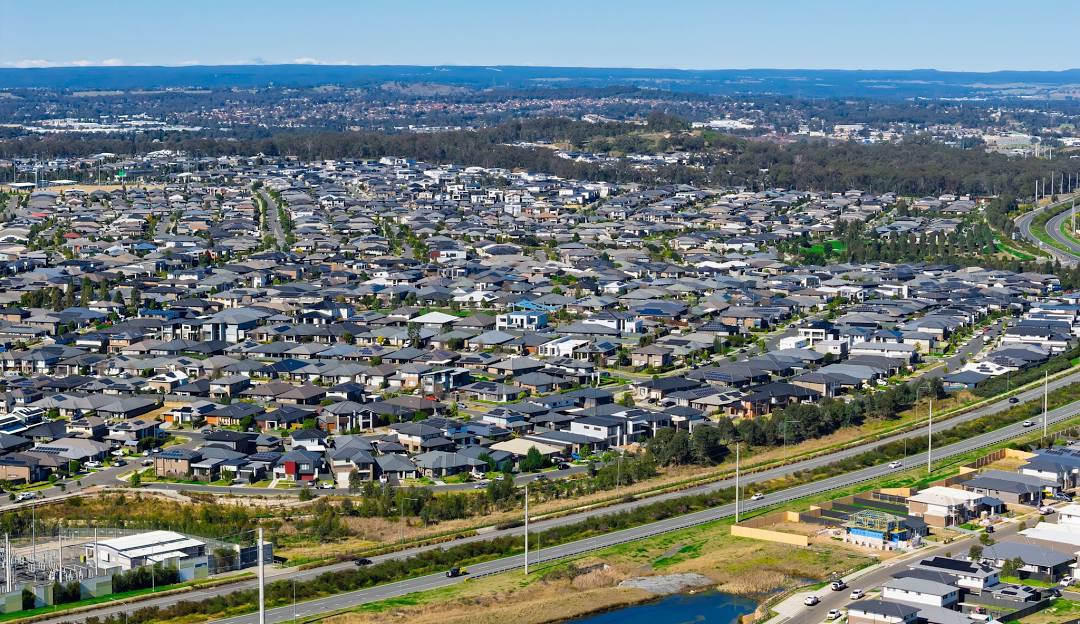
Cost of Living and Housing. Median house prices have pushed past a million dollars, which still surprises locals who remember when this was paddocks. Most homes are new builds on small blocks, double-storey, with the standard south-west Sydney palette of render and brick. Mortgages here are heavy, and many households are running two incomes hard to keep up.
Schools and Kids. Oran Park Public, Barramurra Public and Oran Park High serve the public sector. St Justin's Catholic Primary and St Benedict's Catholic College handle the Catholic stream. Oran Park Anglican College runs Prep through Year 12 on a single campus. Demand is intense and most schools have grown well beyond their original capacity.
Weekend Life. Saturday morning is football at one of the new ovals, then coffee at the Podium. The Oran Park Leisure Centre has become the indoor sporting hub for the south-west, with basketball, gymnastics and aquatic programs running constantly. Families spend a lot of time at Julia Reserve and the network of pocket parks threading through the estates.
Town Centre and Vibe. The Podium is the heart of it: Woolworths, cafes, the library, the council chambers next door. The streetscape is deliberately walkable, the architecture clean and contemporary. It feels engineered rather than organic, but it is filling out, and on weekends the place hums with prams, scooters and teenagers.
Nightlife and Culture. Genuine nightlife is thin. A handful of restaurants and the local pub absorb most of the evening trade. For anything beyond that, residents drive twenty minutes to Campbelltown or Camden, or commit to the trek into the city. Cultural life is mostly school plays, junior sport presentation nights, and the events the council hosts in the Town Centre.
Sydney CBD. About 60 to 75 minutes by road in good traffic, longer in peak hour. The drive in is the daily reality for many residents, though more are working hybrid since the pandemic.
Leppington Train Station. Around 15 minutes by car or via the 858 bus. The future South West Rail Link extension is planned to bring a station to Oran Park itself, but for now Leppington is the gateway to the rail network.
Western Sydney Airport (Badgerys Creek). Roughly 25 minutes north. Due to open in 2026, it is reshaping the economic geography of this entire area and will sit on Oran Park's doorstep.
Campbelltown. 20 to 25 minutes east. The closest major hospital, large retail and the established service centre for the Macarthur region.
Camden Town Centre. 10 minutes south. Heritage main street, the historic core of the district, and a counterpoint to Oran Park's brand-new feel.
Western Sydney University Campbelltown. Around 25 minutes. The closest tertiary campus serving local students.
Saturday morning at the Podium and you see the demographic in full: young couples pushing prams, dads in hi-vis grabbing coffee before a half-day on site, mums in activewear corralling three kids out of an SUV. The median age is 30. Families with children make up more than two thirds of households. This is one of the youngest established suburbs in the country, and the energy reflects it.
The cultural mix is broader than the rest of the Camden area. Indian, Nepali, Filipino and Pacific Islander families have moved here in significant numbers, drawn by new housing and good schools. Hindi, Punjabi and Nepali are spoken in many homes alongside English. The First Nations population sits noticeably above the national average. Tradies, healthcare workers, teachers and small-business owners dominate the workforce, with many commuting to Liverpool, Campbelltown or further into the city.
Comfortable in the chaos of young families. Energetic. At home in a culturally mixed room. Can lead worship that feels alive without being performative, and preach in a way that lands for both the tradie and the IT worker.
Patient with a community still figuring out who it is. Willing to plant in a school hall or community centre for several years before any building conversation starts. Strong on hospitality, slow to judge, fast to turn up at junior sport on a Saturday. A planter who needs an established town with deep roots will struggle here. A planter who loves the raw work of building something from scratch will find their feet.