
Schofields was paddocks fifteen years ago. Now it is a fast-rising suburb in Sydney's north-west growth area, full of new estates, young Indian-Australian families and freshly built schools still finding their rhythm.

Drive north-west out of Blacktown, past Quakers Hill, and you arrive in a suburb that barely existed a generation ago. Schofields sits 45 kilometres from the Sydney CBD, on the Richmond rail line, in the heart of the North West Growth Area. New estates, a refurbished station, a new town centre and the Schofields Village Shopping Centre have transformed what was farmland into one of Sydney's fastest-growing residential pockets.
The eastern side of the suburb is where the build-out has been densest. Streets named after birds and gum trees curve past townhouses, four-bedroom family homes and apartment blocks. Bulldozers still work the edges. The community taking shape here is young, multicultural and arriving with mortgages, prams and ambition.
The aches here are the aches of a brand-new suburb. Mortgage stress is real in households that stretched to buy. Commutes are long. Neighbours who moved in last year do not always know each other yet. Many young parents are raising children far from extended family back in India, the Philippines or Sri Lanka, and the loneliness of that gap is quiet but constant. There are also tensions any rapidly built community feels: traffic, construction noise, schools straining at capacity, a town centre still finding its identity.
The anchors are the schools, the parks and the cultural and faith communities people bring with them. Sport pulls families together at Schofields Park and the new Ken Birdsey precinct. Hindu temples like the SMVS Swaminarayan Mandir on Grange Avenue, the Lankarama Buddhist Vihara, and a growing number of small ethnic congregations carry significant social weight. The school gate at Galungara and Schofields Public is where new friendships actually form.
Schofields is one of the strongest demographic profiles in greater Sydney for a young-family-shaped plant. Two-thirds of households are families with children. Nearly one in three residents is aged between 15 and 34. The median age is 31. The suburb is still forming, still adding streets, still adding families every month.
The cultural moment is a generation of young Indian, Filipino, Sri Lankan and Pacific families who arrived with strong faith instincts but not yet locked into a local English-speaking church. Their kids are growing up Australian. Many parents are open to a contemporary Christian community that takes their cultural background seriously, welcomes their kids, and gives them somewhere to belong outside of work and the school run.
It will not be glamorous work. Building community in a suburb that is still under construction is slow, and reaching multicultural young families requires real cross-cultural humility. But the demographic ingredients are unusual: large, young, family-heavy, growing fast, spiritually open in a way the national average is not, and currently underserved by contemporary English-speaking Pentecostal expression. The opportunity is to plant something now that grows alongside the suburb itself.
Schofields does not fit the standard Australian secular story. The non-religious share sits well below the national figure because the suburb's demographic weight is tilted toward Indian, Filipino, Sri Lankan and Pacific families for whom faith is woven into daily life. The trend here is not a drift away from religion but a reshuffling of which religion dominates the street: Hinduism is the largest single affiliation, Catholicism is strong, and Christian identification overall is lower than the national average not because people have abandoned belief but because the cultural composition is different.

The closest C3 expression is C3 Church Rouse Hill, planted in 2015 by Tim and Sue Gardiner, meeting at Rouse Hill Public School about ten minutes away. Hillsong's Hills campus sits in the broader Norwest area. New Light Anglican Riverstone runs an evangelical, multilingual ministry serving Schofields and surrounds, with translation in Hindi, Punjabi, Gujarati and Urdu. There is a Romanian Pentecostal congregation on Carnarvon Road serving its own language community.
The gap inside Schofields itself is a contemporary, English-speaking Pentecostal church embedded in the suburb rather than reached by a ten or twenty minute drive. Twenty-five thousand residents, the demographic centre of gravity firmly in young families and young adults, no Pentecostal or charismatic plant on the ground inside the SA2 boundary, and a population still forming the habits and friendships that will define the next two decades.
Cost of Living and Housing. Schofields is north-west Sydney pricing, which means cheaper than Castle Hill or Kellyville but well into seven figures for a freestanding home in the newer estates. Apartments at developments like Schofield Gardens start around the mid-$500,000s for a one-bedroom. Most buyers are first-home or upgrader families stretching into the loan to get a backyard within reach of the train.
Schools and Kids. Schofields Public School and Galungara Public School anchor the primary years. St Joseph's Primary covers the Catholic stream. The Ponds High School and Quakers Hill High School are the main secondary options, both within easy reach. Wyndham College sits in the old Nirimba site to the south. New schools keep opening as the demographic wave moves through.
Weekend Life. Saturday mornings revolve around junior soccer at Schofields Park, cricket in summer, and weekend cooking with extended family. Glory Park, Schofields Park and Altrove Hilltop Park give the kids somewhere to run. Ken Birdsey Park, a 20-hectare sports and recreation space on Sciberras Avenue, is due to open in mid-2026 and will add four sports fields, cricket nets and walking paths.
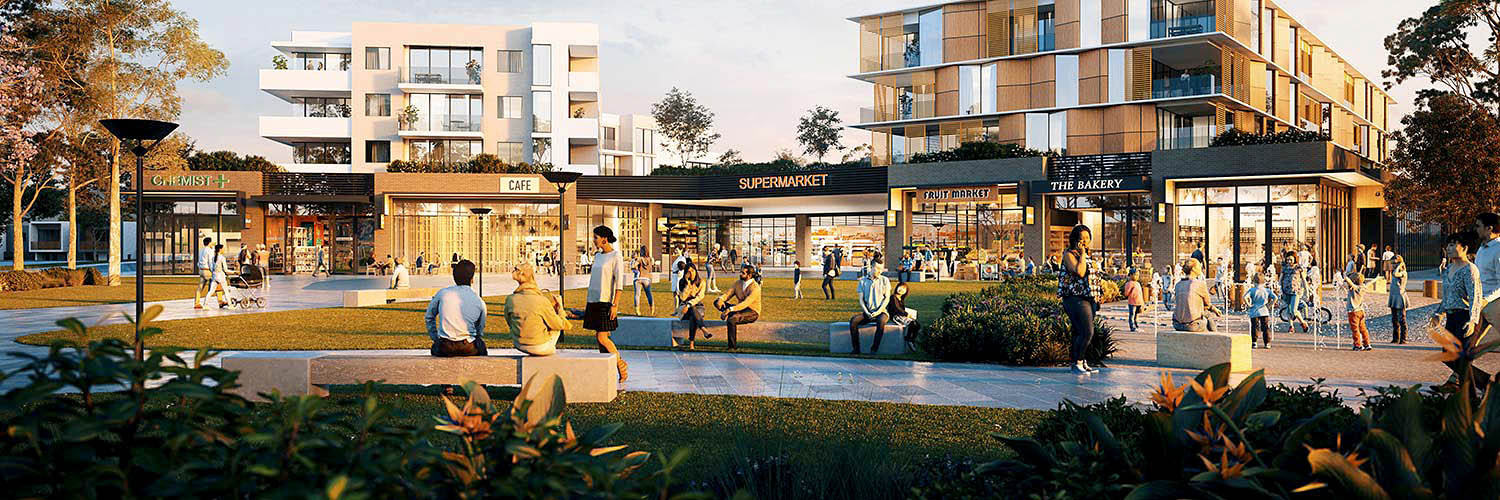
Town Centre and Vibe. The town centre is new and still settling in. Schofields Village Shopping Centre opened in mid-2021 across from the train station, anchored by Coles, with a Woolworths nearby. Cafes, takeaway, a chemist, services. It is functional rather than pretty, but it works for a quick coffee or the after-school grocery run, and the surrounding apartment buildings give it a steady weekday crowd.
Nightlife and Culture. There is no real nightlife in Schofields itself. For a meal out or a movie, families drive five minutes to Rouse Hill Town Centre, with its 250-plus stores, Reading Cinemas and the strip of restaurants along Main Street. The cultural texture is multicultural and home-based: Diwali decorations on streets in October, family parties spilling out of double garages, the smell of biryani drifting from kitchens on a Sunday afternoon.
Sydney CBD. Around 45 to 60 minutes by Sydney Trains on the T5 line direct from Schofields station, or 50 minutes by car off-peak via the M7 and M2.
Parramatta. 25 to 30 minutes by car or train. The closest major business district and the practical CBD for most working residents.
Rouse Hill Town Centre. 5 to 10 minutes by car. The default destination for shopping, cinema, dining out and Sunday browsing.
Norwest and Castle Hill. 15 to 20 minutes via the Sydney Metro from nearby Tallawong, or by car. Major business park, Norwest Private Hospital, Castle Towers shopping.
Western Sydney International Airport (Badgerys Creek). Around 35 to 40 minutes by car. Set to reshape job patterns across western Sydney once flights commence.
Blue Mountains. 40 minutes west to the foothills at Penrith, an hour to Katoomba. The standard weekend reset for north-west Sydney families.
Saturday morning at Schofields Park, the carpark fills with SUVs and people-movers. Kids in soccer kits, parents balancing coffees, multiple generations on the sideline. The dominant ancestry here is Indian, with Hindi widely spoken at home alongside English. Filipino, Sri Lankan, Pakistani and Nepali families are well represented too. This is the new Sydney middle class: dual-income, university-educated, often working in IT, healthcare, finance or the trades, commuting to Parramatta, Norwest or the city. Many are first-generation homeowners. Most are under 40.
Religiously the picture is striking. Hinduism is the largest religious affiliation in the broader suburb. Catholicism is the second largest. Christian affiliation overall sits below the national average, and the non-religious share is much lower than the national figure, because so many residents come from cultures where religious identity is strongly held. Add a notable First Nations population and a layer of long-standing Anglo-Australian families who remember when this was paddocks, and the human picture is genuinely diverse, young and family-shaped.
Cross-culturally fluent, comfortable in a room where most accents are not Anglo-Australian, genuinely curious about Indian, Filipino and Sri Lankan family life. Family-stage themselves, ideally with school-age children, because the social currency here is the school gate and the soccer sideline. Patient with a community still figuring out who it is.
Not for the planter who needs an established cafe scene, an inner-city aesthetic or a built-in young adult crowd of single twenty-somethings. The work here is slow, family-based and relational. The planter who thrives is the one who shows up at junior sport, learns a few words of Hindi and Tagalog, and is willing to plant deep roots in a suburb that is still being built around them.